
A Philosopher, Physicist, & Architect Walk Into a Substack Post...
Why Education Should Be About Integrating Knowledge, Not Just Specializing In It
This week we are reading Chapter 4 of Beauty in the Word, and the section Some Moral Habits—Obedience in Home Education.

In Chapter 4 of Beauty in the Word, Stratford Caldecott borrows from Hugh of Saint Victor to define education broadly as “the pursuit of Wisdom,” and to equate it with Philosophy. Philosophy, which means “love of Wisdom,” encompasses all branches of knowledge. While we tend to equate philosophy with theoretical knowledge, philosophy also includes practical, mechanical, and logical knowledge as well. This kind of knowledge, the kind that pursues true Wisdom and the integration of all branches of knowledge, is not just a seeking of facts. It is a seeking of meaning.1
These different kinds of knowledge are necessary and dependent upon each other. They all require images, imagination, metaphor, analogy, and symbols. Our bodily experiences are not separate from our imaginative ones. Science is connected to beauty, language to images, mathematics to metaphor. Widening our knowledge in each branch of knowledge opens up more knowledge for us in another. Knowledge is deeply interconnected. We harm our ability to know and to fully live when we try to artificially rip them apart.2
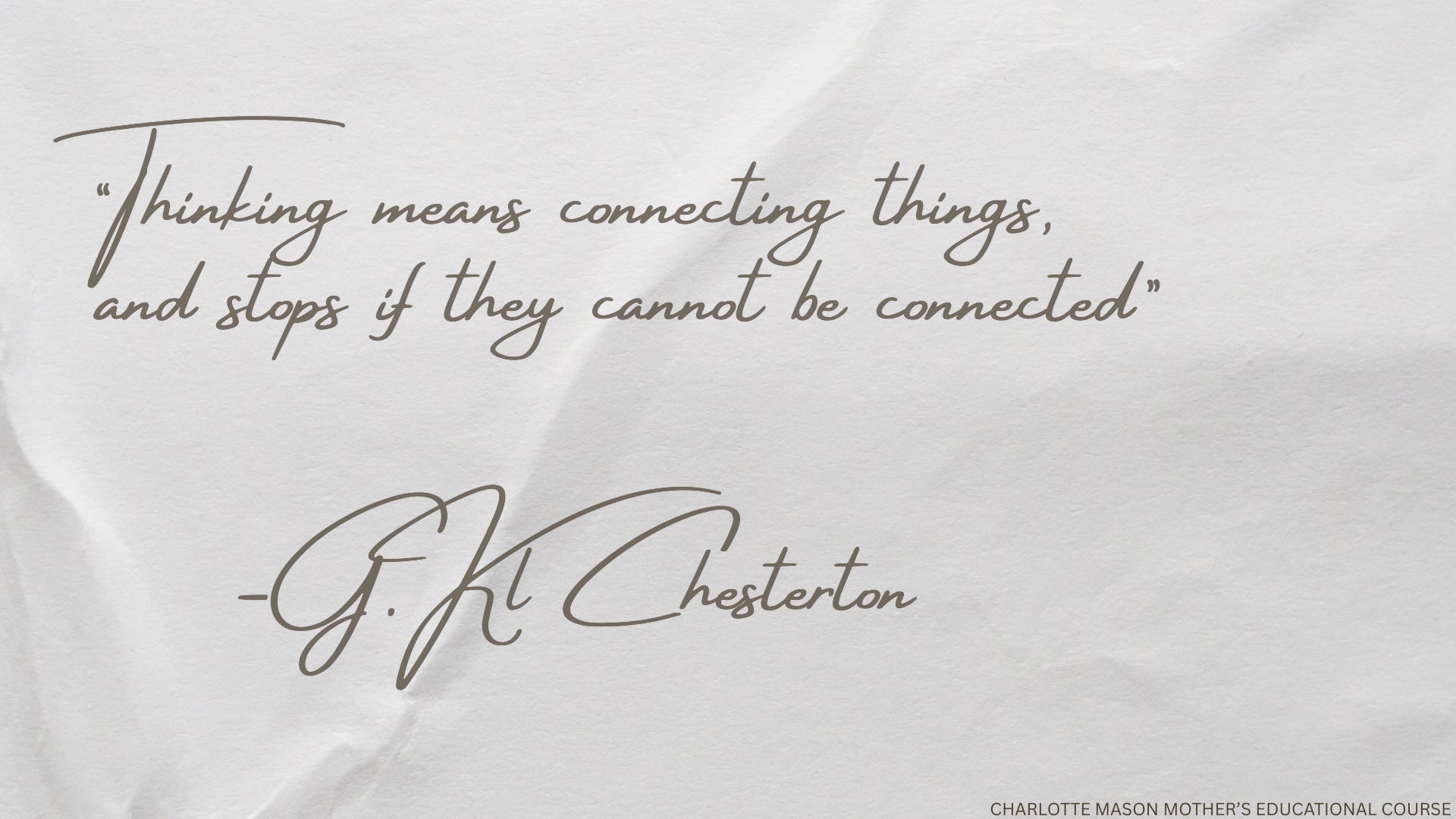
We also dehumanize our subjects of study when we try to isolate them. Nuclear physicist Robert R. Wilson, who was also a sculptor, reflected on this idea in an essay titled The Humanness of Physics:
“One of the greatest failures is the inhumanness of the world of physics. Physicists, not unnaturally, have taken the business of physicists to be the creation of physics. The business of physicists should also be concerned with the poetry and drama of physics, with the beauty of its form and function.”3
Artificial divisions strip our work of what makes it humane. Dr. Wilson believed that separating physics from beauty dehumanized it. Science writer and author J.W.N. Sullivan wrote, “The measure in which science falls short of art is the measure in which it is incomplete as science.”4 There need not be any division between beauty and truth. Our knowledge is incomplete if we cannot comprehend both.
Dr. Wilson went on to describe the role beauty and aesthetics played when he designed particle accelerators:
“So how do I go about designing? Well, I find out a little here, by a simple calculation, and a little there, by a string of such calculations, about parts of the most important technical components. I then sketch those parts of the design on paper. After that, I just freely and intuitively draw in neatly appearing smooth lines, lines which cover my ignorance of detail. I keep drawing, correcting here and there by calculations until the accelerator takes form and appears that it might work. Mostly I know it might work because it looks and feels right-not because of any long and detailed chain of calculations, which after all might take forever. It is when the parts and forms have essentially the same relationship that the parts of a sculpture should have to the whole that I am satisfied by the design. Of course, building, even designing, a large accelerator is a complex team activity - just as it was for the cathedral. But if the conceptual design is aesthetically right, then one can depend on the members of a team to appreciate and to understand and to respect that aesthetic form in their own creative contributions. An accelerator that is ‘understood’ works. What I am trying to express by a certain amount of exaggeration is that most of the effort of design is intuitive, that aesthetics are indeed a valuable and necessary guide in any design process, that these very human qualities are an important part of physics and give to physics a quality of humanness.”5

Can you see the beautiful interplay between art and science here?
The accelerators Dr. Wilson created revolutionized the scientific and medical communities. His work led to many scientific discoveries, including proton therapy as a cancer treatment and laying the foundation for the eventual development of MRI machines.6 Dr. Wilson’s knowledge of art and sculpture benefited the world of nuclear physics and medical science (and his understanding of physics undoubtedly played a role in his ability to produce art as a sculptor). Knowledge holds together.
Remember that Caldecott said the key to wisdom is to understand “the unity or interrelationship of all human knowledge.”7 If education is the pursuit of wisdom, then, as Charlotte Mason says, it “must leave the pupil attached to the world at many points of contact.”8 We must understand differing subjects not as “specializations” but as integrated knowledge with a coherent unity.
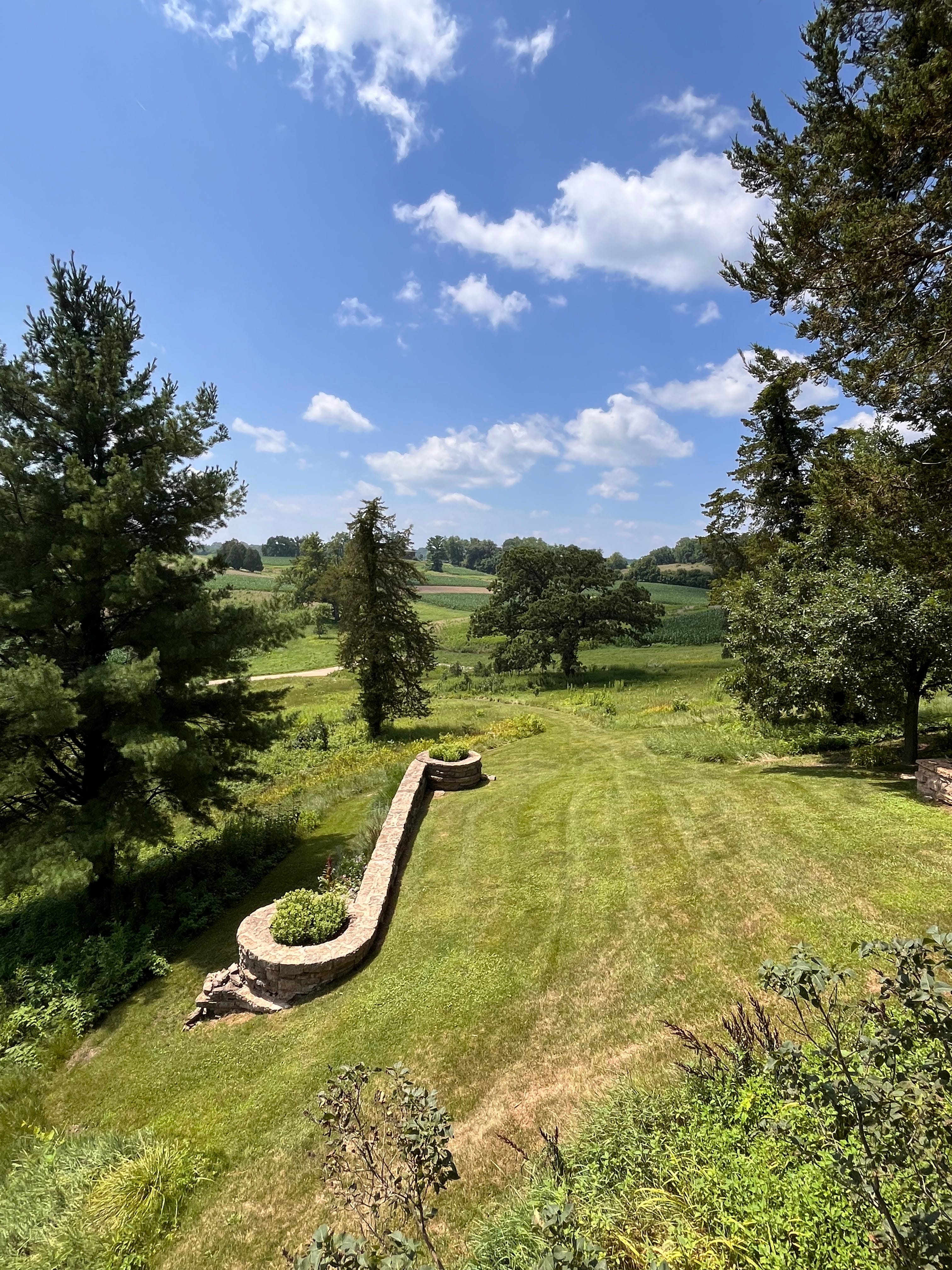
Last week my husband and I toured Frank Lloyd Wright’s home in Spring Green, Wisconsin. I was surprised to hear our tour guide point to one of the many pianos in the home and say, “Music was one of the biggest influences on Frank Lloyd Wright’s architecture.” Music was one of the influences that made his iconic architecture a reality. As I glanced out the window at his music-note-cisterns, it seemed as if I was looking at a visual symbol of the way form, function, and knowledge are capable of unity.
Allow me one more quote from Dr. Wilson (last one, I promise):
“I take the optimistic view of man. He will survive the inhumanities of his technological culture, and I believe that his culture will evolve to a new and richer level-that he will create a new world. But I agree with T.N. Whitehead that ‘unless we can make man, his culture and his ideals, of central importance to the physical scientist in his own work, we are in serious danger of sinking to the level of technologically skillful barbarians.’”
I fear we are dangerously close to the “technologically skillful barbarians” he is speaking of. But if we can remember the cultural inheritance of our humanity, and unify our knowledge back together, I believe, like Dr. Wilson, that there is hope. And I believe, like Stratford Caldecott, that this work of remembering happens in our homes and in our schools, and ultimately points us back to the “living Mind” that knowledge originates in. It’s time to remember our Philosophy.9
SOME HOUSEKEEPING
I am scheduling an impromptu catch-up week next week. You won’t hear from me next Sunday, but you’ll find me back in your inbox in August!
RESOURCES & DOWNLOADS
Home Education Audio: You can listen to the audio version of Home Education for free on LibriVox. This week we are reading section 41.
Fermilab’s “Golden Books” Collection: Dr. Wilson’s essays are available to read for free at Fermilab’s website. Fermilab is the national laboratory Dr. Wilson designed and directed.
Church Year Cookbook (paid subscribers): 12 visual recipes for the liturgical year! Complimentary for paid subscribers during the month of July.
Church Year Cookbook
·
Paid subscribers can download The Church Year Cookbook below, a collection of 12 visual recipes for the liturgical year, including Advent, Christmas, St. Nicholas Day, Epiphany, Candlemas, Valentine’s Day, St. Patrick’s Day, Shrove Tuesday, Lent, Good Friday, Easter, Michaelmas,

Beauty in the Word, page 106. See also pages 110-111.
Beauty in the Word, page 109.
The Humanness of Physics by Robert R. Wilson.
Quoted in Beauty and the Quest for Beauty in Science by Subrahmanyan Chandrasekhar.
The Humanness of Physics by Robert R. Wilson.
Early in his career, he was also part of the team that helped develop the technology that eventually led to the atomic bomb. He remained deeply conflicted about the role he played in the bomb. Prior to the war, and in the early days of it, Wilson was a pacifist. Eventually, Wilson was asked to use his scientific expertise for the war effort. It was believed that Germany was also trying to develop a nuclear weapon, and Wilson felt he could not stand by and watch Nazi Germany take over the world. As he became wrapped up in the project during wartime, he experienced firsthand what happens when the technicalities of science are divorced from considerations of humanity and morality: “My re-awakening from being completely technically-oriented came dramatically on July 16 as I experienced the test explosion of the first nuclear bomb…. That which had been an intellectual reality… had suddenly become a factual, an existential, reality. There is a very great difference.” He spent the rest of his life trying to do his professional work with humanity, morality, and beauty in mind. You can read more in The Conscience of a Physicist.
Beauty in the Word, page 9.
Home Education Preface.
Beauty in the Word, page 110.